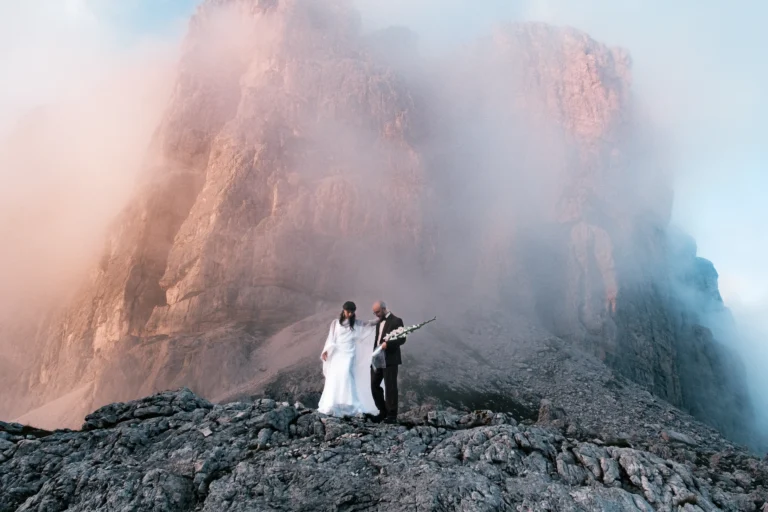
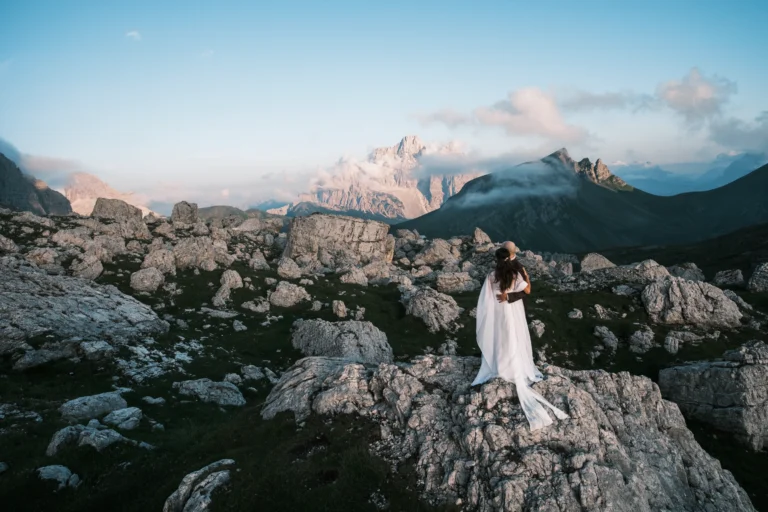
GROSSGLOCKNER · AUSTRIAN ALPS
Grossglockner Elopement
Glacier views, a slow morning together, and a wedding day with room to breathe. A personal guide to getting married in Austria’s Grossglockner region.
By Elias Choi-Buttinger · Bound of Music
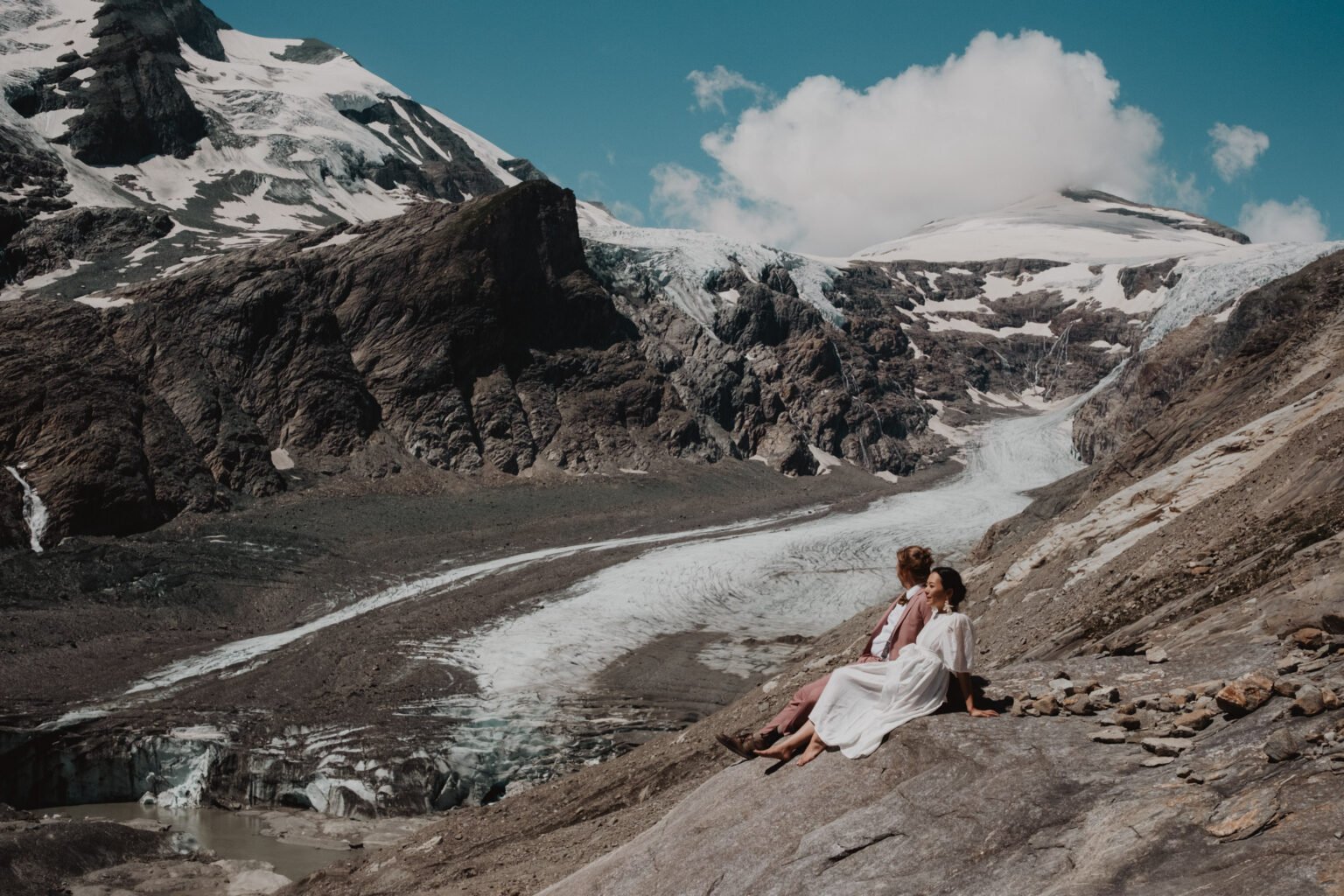
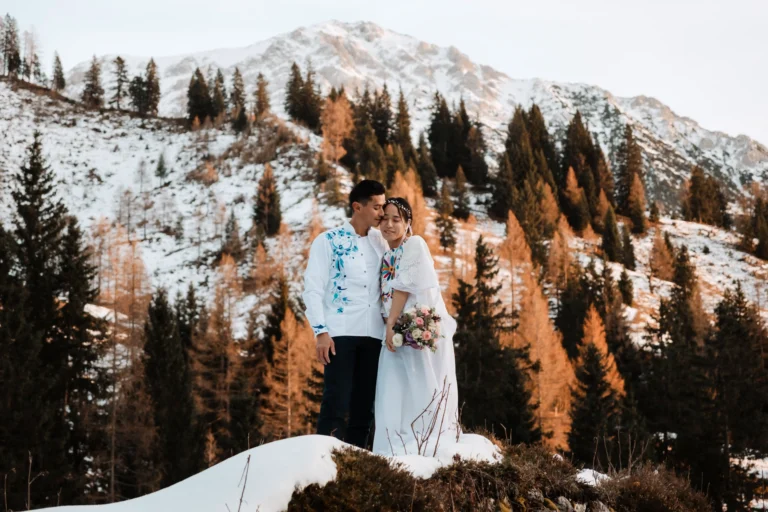
A photograph from my work in the Grossglockner region. The landscape is part of your day; the two of you are the reason for it.
You might arrive here because of one photograph: a couple, very small against a huge landscape of rock and ice. And then the practical questions begin. Can we actually get married there? Do we need to climb? Where would we stay? What happens if the mountain disappears into cloud?
A Grossglockner elopement can include an accessible mountain outing, a carefully planned symbolic ceremony, or a legal wedding in the valley followed by photographs in the region. Those are different plans, with different permissions and logistics. The first step is choosing what you want to experience together.
My first really clear memory of this place is a bike ride with my father. Later, photographing a dancer and a barista here gave me a different set of memories: coffee in the morning sun, a rock like a guardian in the fog, a veil in the wind, and the Pasterze glacier landscape. I’ll share that story alongside the practical things you need to plan your own day.
This guide focuses on this particular region. For the wider booking order, family conversations and full checklist, keep my elopement planning guide beside it.
A dancer, a barista, and two days in the mountains
The couple in these photographs brought a lovely combination of worlds with them: she is a dancer from Japan who lives in Austria; he is Austrian and a barista. We spent two days shooting in the Grossglockner region, with an overnight stay lower down the mountain. That gave us time for very different places and, the next morning, some light I still remember clearly.
The guardian in the fog
On our drive up, we passed through a band of cloud. The valley had been clear, then suddenly the world became soft and grey. Beside the road we noticed a remarkable rock formation. To me it looked like a guardian watching over the mountain road.
We stopped there for photographs. The fog hid the wider landscape and left us with the couple, those beautiful rocks and a completely different atmosphere. Later, as we continued higher and crossed to the other side, we came out of the clouds again. Suddenly there was all that space: mountains, light, waterfalls on the opposite slopes. It felt as though we had arrived in another world.
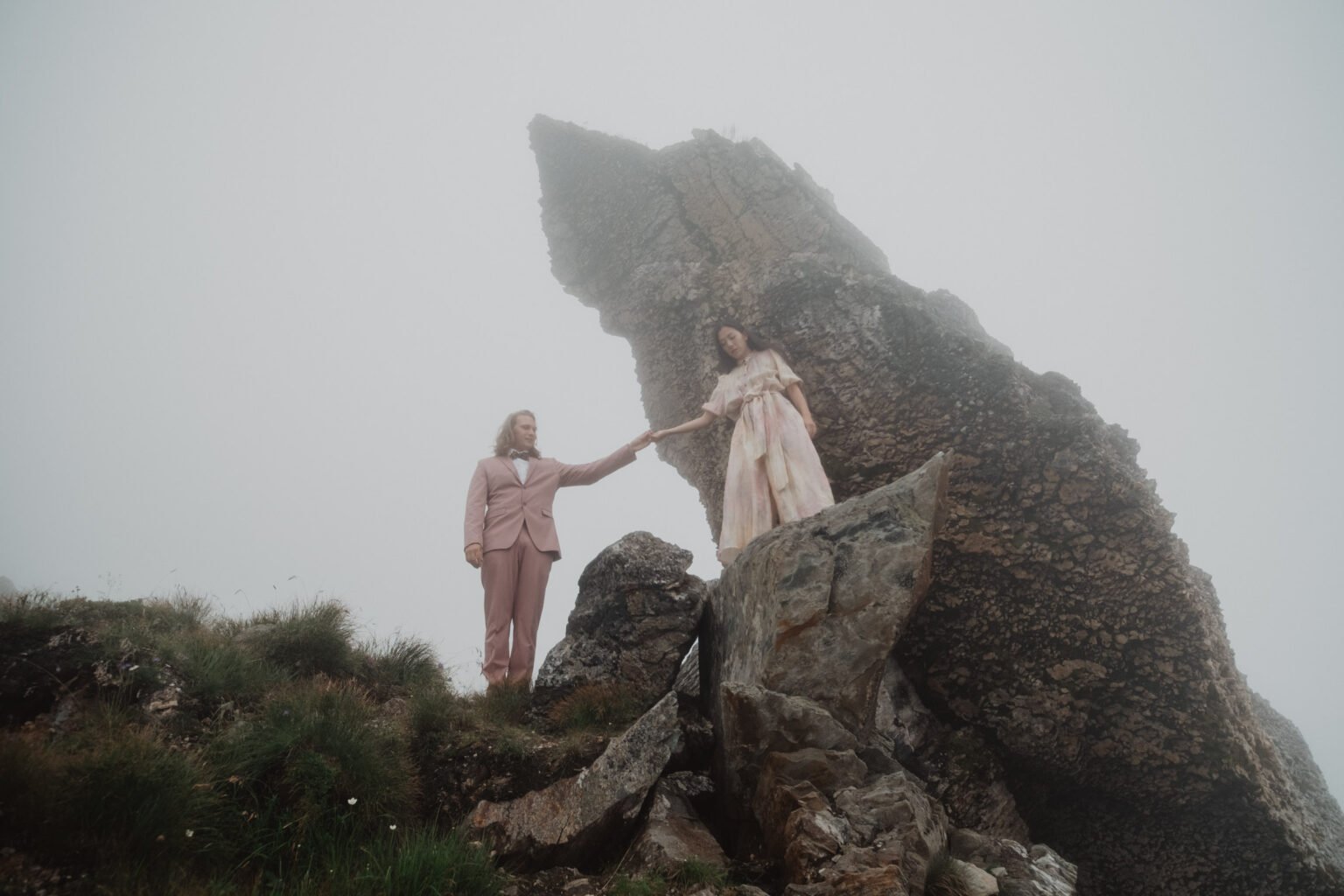
The rock that reminded me of a guardian of the mountain road.
Green meadows, waterfalls and a veil in the wind
Before continuing towards the Pasterze, we stopped by a waterfall near the road. I remember green mountainsides, water coming down between the rocks, a reservoir below and high mountains all around us. The wind caught her veil, and we made photographs with that movement rather than trying to keep everything perfectly still.
We also photographed them by the water, where little patches of land broke up the surface. He spotted an edelweiss along the way. Those small discoveries belong to my memory of the day just as much as the enormous views do.
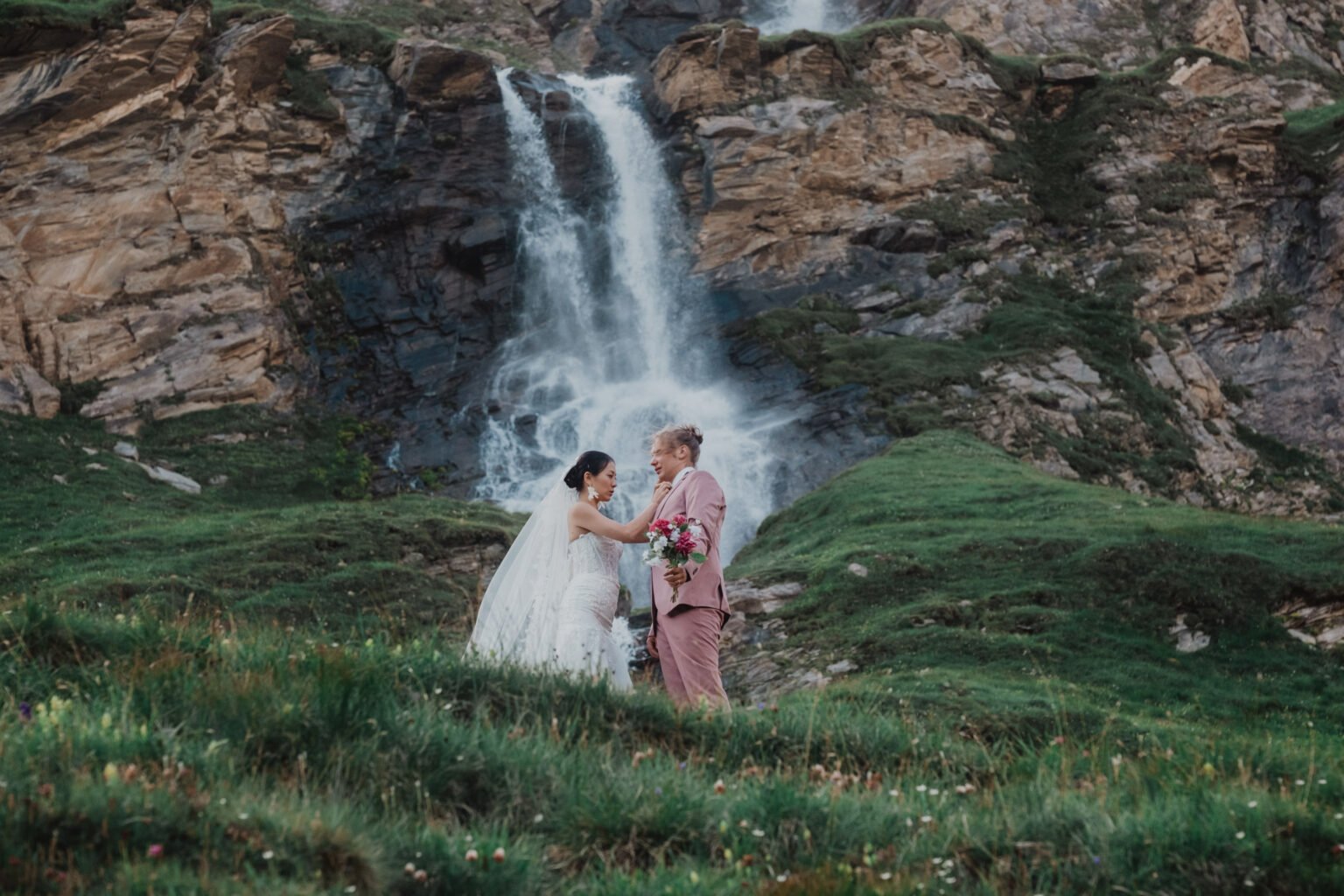
The wind, the veil, and a much greener side of the Grossglockner region.
The walk to our waterfall stop felt short—roughly ten minutes on that visit. For planning, the operator lists the waterfall at the Nassfeld reservoir about 400 metres from the road. We would still check the actual path, water level and permitted places to stop for your day. Water levels and access can change, so we choose the actual spots afresh.
At the Pasterze, the landscape tells another story
We continued towards the Kaiser-Franz-Josefs-Höhe and the Pasterze. On that visit, the funicular took us part of the way down; we walked the remaining descent into the glacier basin. From there, the landscape opened into rock smoothed by the ice, meltwater and the mountains beyond. Of all the places I had seen in Austria, this was the one that reminded me most of Iceland: raw, rocky, with very little vegetation.
It was a wonderfully warm day. We were walking in T-shirts, and for a while she was barefoot on the rocks. That contrast stayed with me: feeling the warmth while surrounded by this raw landscape of rock and ice. It describes the conditions we happened to have; for your own visit, bring proper walking shoes and warm layers.
We didn’t reach the glacier’s edge. A stream carrying too much meltwater crossed our route, and I wasn’t comfortable taking the couple across it. We chose a different viewpoint on the rocky slopes, with the glacier below us in the background. The photographs from there are some of the views you see in this guide.
I also remember the marmots around the viewing area, and the historical pictures and markers showing where the ice used to be. Looking at that enormous basin, and then imagining it filled with ice, made the scale of the change very real to me. The Austrian Alpine Club’s monitoring documents the Pasterze’s continuing ice loss.
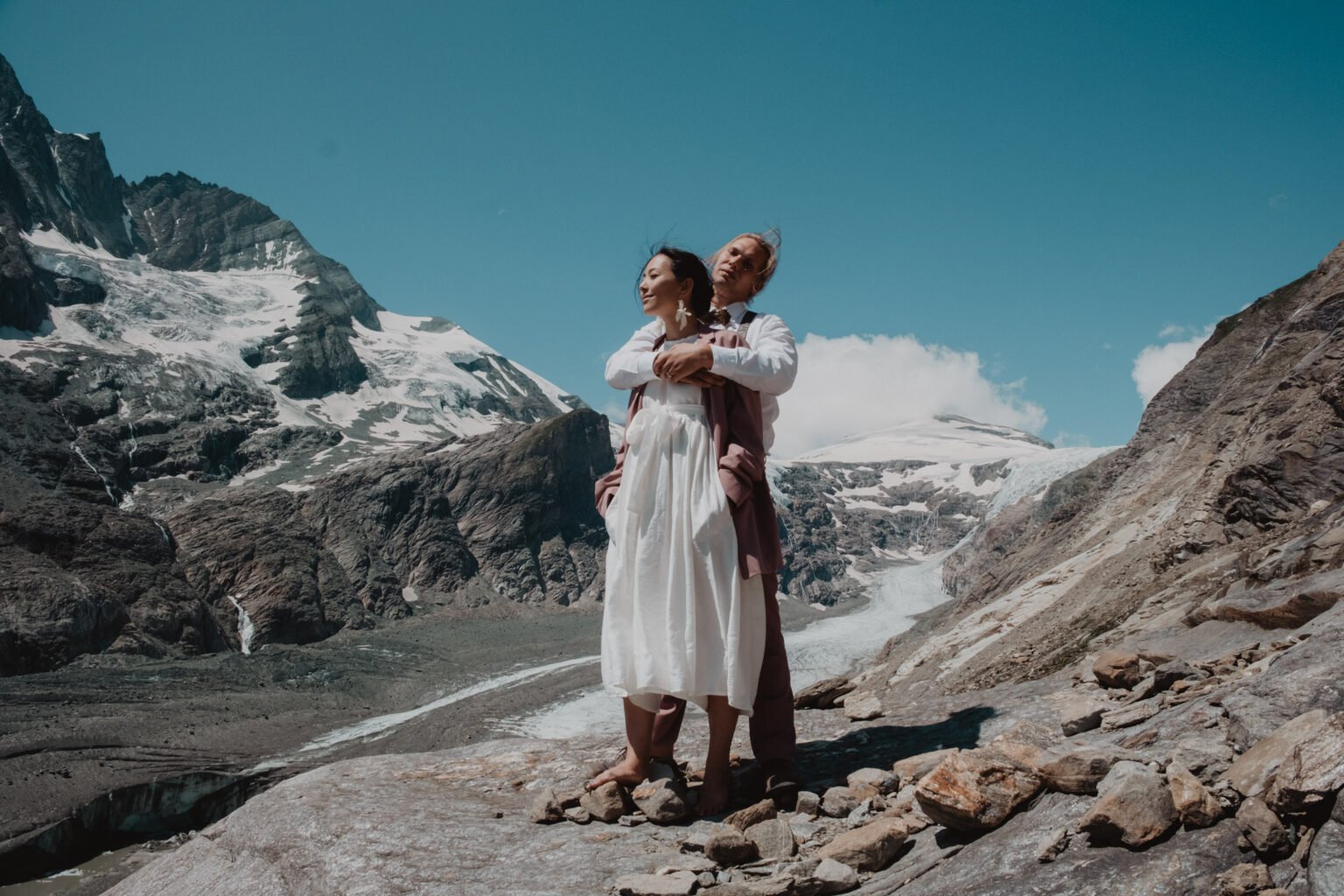
From green meadows to rock, snow and ice: very different landscapes within one region.
The second morning: sunlight, wildflowers and coffee
After sleeping lower down the mountain, we got up for sunrise. The sun came over the mountains to our left, and the mist made its rays visible as they cut into the valley. We found mountain meadows with tall wildflowers, and the couple enjoyed the morning together while I photographed them.
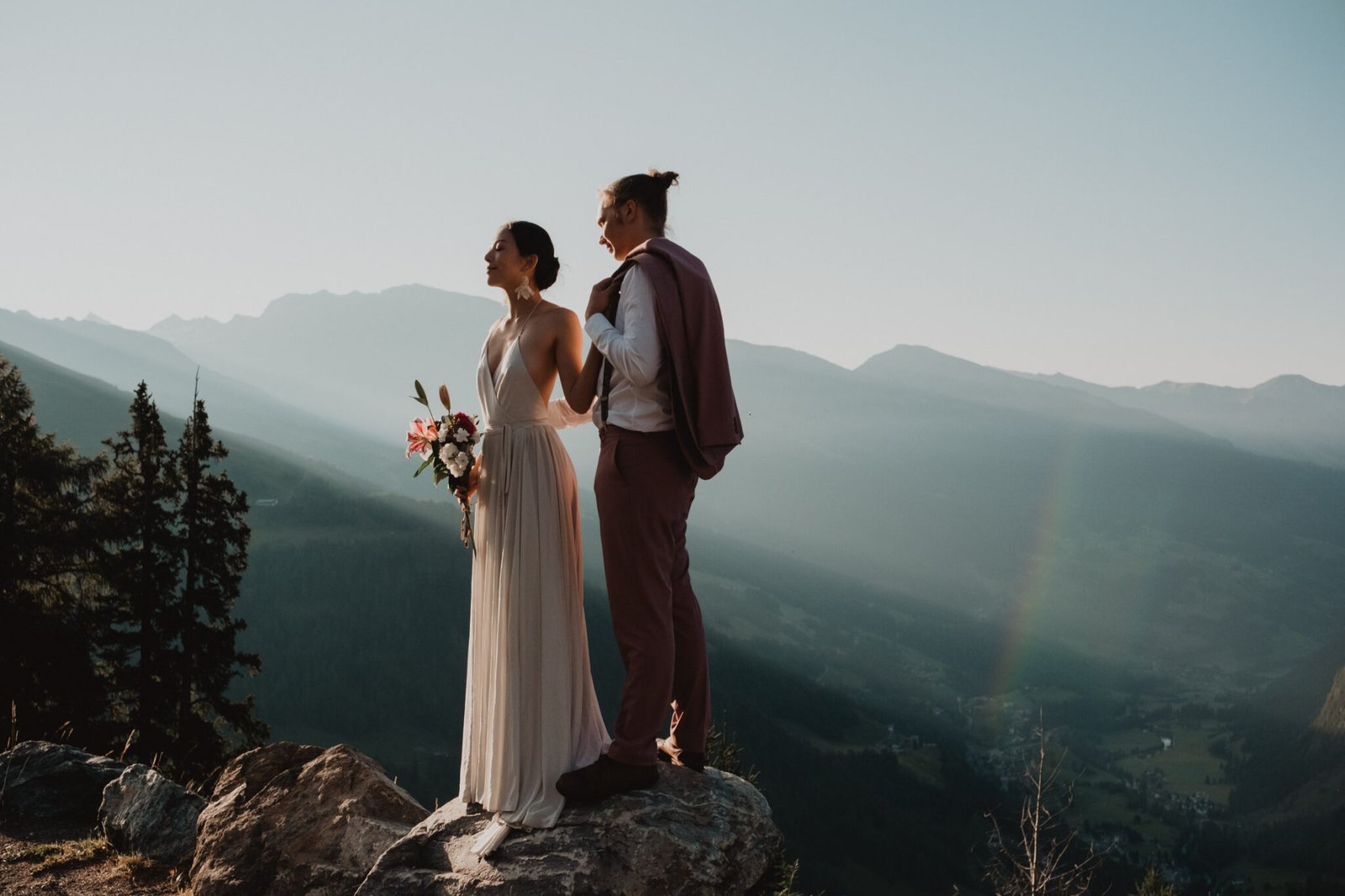
Morning light, a bouquet, and a quiet moment above the valley.
Then came coffee on a little terrace beside the road, with an enormous view into the valley and across the mountains. For a barista, it was such a natural thing to bring into the experience. For me, it is the combination I remember: that clear mountain air, the light, and the two of them taking their time over something familiar.
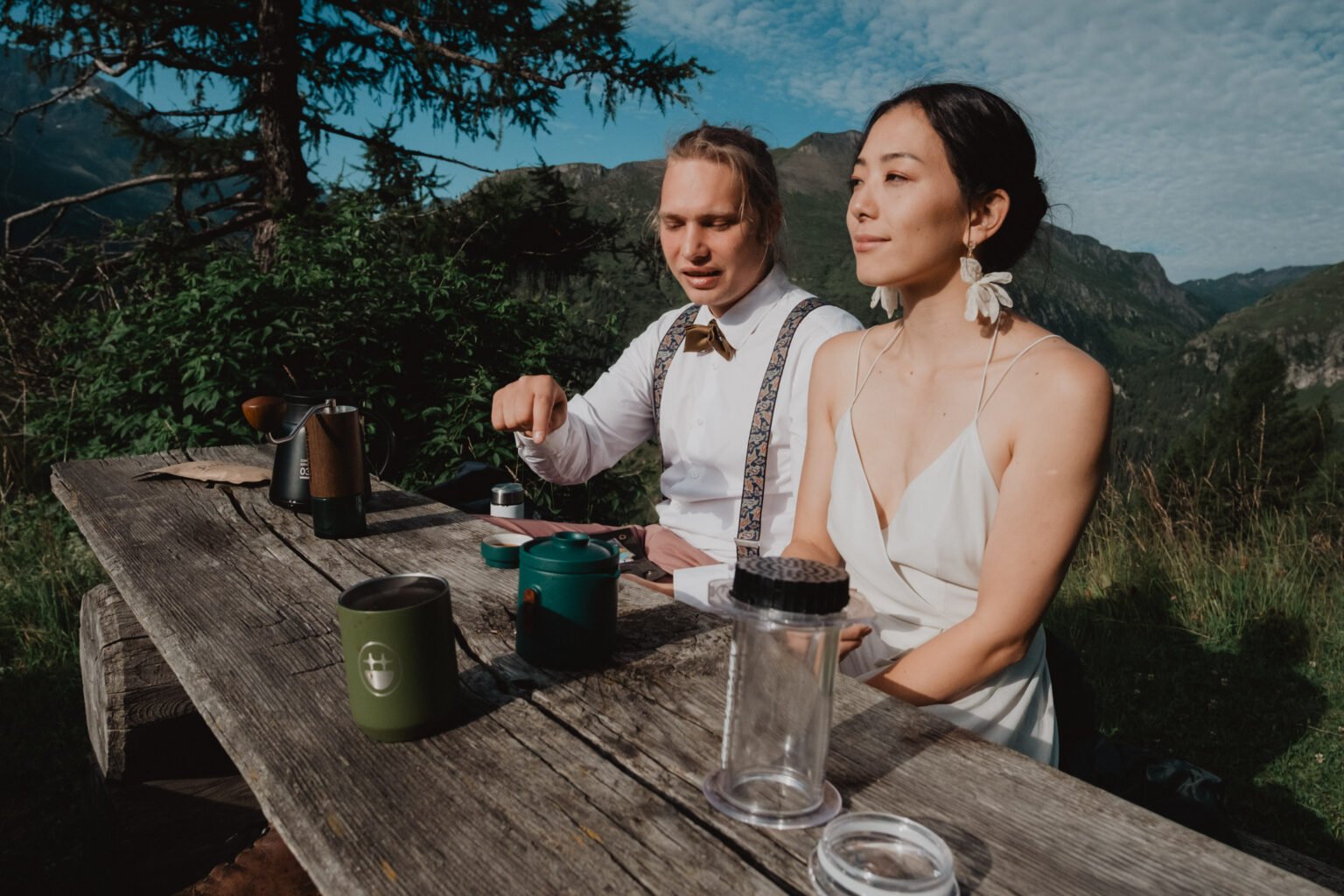
The second morning: coffee together after sunrise in the mountains.
That is why I like making room for something you already enjoy together. Your wedding day can hold a huge landscape and a very ordinary little ritual. Both deserve time.
For your own day, I would choose the parts of this experience that suit you. You might want coffee and a short walk, or a longer outing with time to explore. This shoot is inspiration; your day does not need to follow every stop we made.
First, choose your side of the mountain
The Grossglockner summit sits on the boundary between East Tyrol and Carinthia. Salzburg is part of the approach on the High Alpine Road. That distinction matters when you book accommodation: a hotel with “Grossglockner” in its description may be on a very different side from your chosen place.
Fusch, Bruck & the Salzburg approach
A possible base if your plans begin north of the mountain. The High Alpine Road continues towards Heiligenblut in Carinthia. Choose this side when it fits the whole day, including your registry office and dinner.
Heiligenblut & the Carinthian approach
A possible base for a day centred on the southern approach and the glacier-viewing area. Keeping your accommodation, getting ready and evening meal on the same side can make a small wedding feel much calmer.
Kals & East Tyrol
A separate mountain experience. The Kalser Glocknerstraße leads towards Lucknerhaus and Glocknerwinkel, with views of the mountain from the East Tyrolean side. It does not connect across the summit to Heiligenblut.
The High Alpine Road runs between Fusch and Heiligenblut; the Kals approach is a separate road. Put the actual overnight address, ceremony address and meeting point into your route plan before reserving anything. A map pin on the summit is not a driving destination.
I would usually build an intimate day around one side. Otherwise, the hours that could have been breakfast, vows or a walk together can disappear into transfers.
Why this road is personal to me
Cycling the Grossglockner High Alpine Road runs through my family. As far as I know, the tradition goes back to my great-grandfather. My father rode it with his father, and I later rode it with mine.
I’m not a trained road cyclist. I mostly use a bike around the city, and I hadn’t done a proper training programme for our ride. My father had prepared seriously and was much quicker. For me, on those steep sections, speed stopped being the question. It was about keeping the pedals moving at all. A few times I nearly gave up. Somehow, with the fitness I had from dancing and moving so much, I made it up.
I was proud, honestly. And I remember a beautiful sunny day with my father. I may have visited as a child, but that ride is my first really clear memory of this place. Returning here with a couple brought another kind of story to a road that already meant something to me.
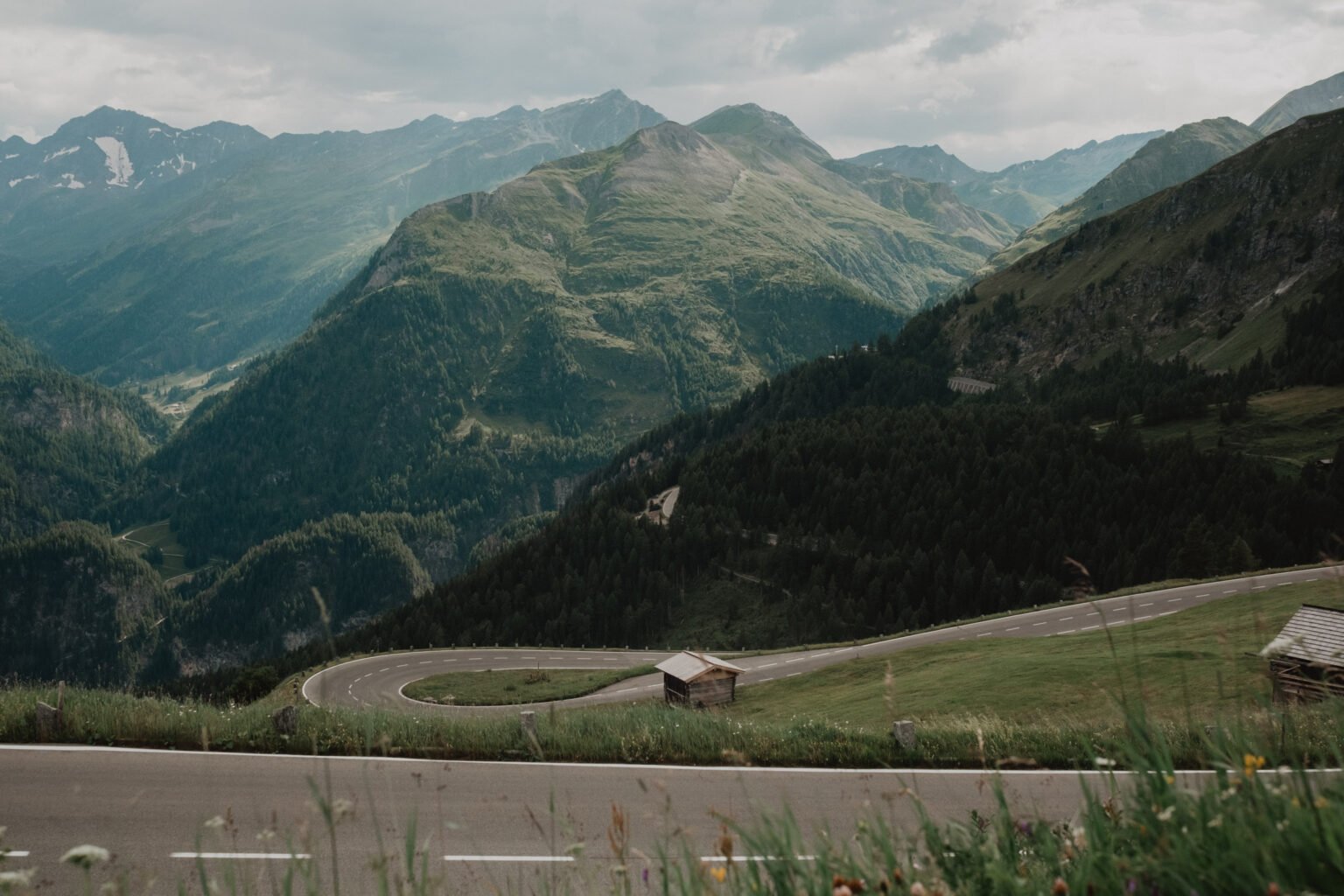
A beautiful drive can belong to the experience. It still needs time in the plan.
Can we legally marry at the Grossglockner?
In Austria, the legally binding ceremony is conducted by a registrar. An outdoor location needs the relevant registry office’s agreement. A beautiful viewpoint, a celebrant or a venue booking alone does not make a ceremony legally binding. The official civil marriage information explains that distinction.
A registry-office wedding, then time in the mountains
This is a lovely possibility if you want the legal wedding and your mountain experience on the same date. Start with the registry office and work outwards: the appointment, your accommodation, the drive, an appropriate place for personal vows and your meal afterwards. You can also complete the legal ceremony on another day and give this day entirely to the experience.
For the southern side, ask the municipality of Heiligenblut; for East Tyrol, contact the municipality of Kals. Ask which ceremony venues they currently approve, how early dates can be reserved and what applies to your circumstances. These are starting contacts, not a promise that a particular viewpoint is approved.
The official symbolic wedding option on the High Alpine Road
There is also an official Symbolic Wedding Ceremony offer. This does not include a legal civil marriage; arrange that separately with the relevant registry office. The road operator names Susanne Schöndorfer and Doris Wallner as the exclusive team for organising, designing and coordinating these weddings, with limited availability. Your first contact is Susanne Schöndorfer for a Grossglockner ceremony. She helps clarify dates, locations, access, permissions and costs, and offers ceremonies in German, English and French. If you would like my photography or a film, we can coordinate with her and the wedding planner so the ceremony and time for pictures fit together.
If you’re travelling from abroad
You can marry in Austria without living here. Your documents depend on your nationality and personal circumstances; ask the registrar before arranging translations or booking non-refundable travel. The Austrian government’s information for non-resident couples is a useful starting point. Also check how the marriage is recognised in your home country.
The question I would settle first
Do you want the legal ceremony on this exact day, or would a separate civil wedding give you more freedom? Neither choice makes your personal vows less meaningful. It simply changes the shape of the plan.
When is the best time for a Grossglockner elopement?
For a day using the High Alpine Road, its operating season comes first. It normally opens around early May and closes around early November, depending on conditions. Daily opening hours also vary. Check the operator’s current dates and hours before choosing a date; sunrise or sunset does not automatically fall within permitted driving hours.
Early season
Choose it because you are comfortable with flexibility. Snow and changing access can affect the places you imagined. Keep a lower-altitude alternative that you would be happy to use.
Summer
This is the season I would explore first for a relaxed day with several outdoor elements. Allow for other visitors, changing mountain weather and time to stop without rushing between locations.
Early autumn
Worth exploring if you love a quieter visual mood and shorter days. We would plan the light, road closing time and warm clothing together, rather than fitting an ambitious summer schedule into less daylight.
Winter
Build a different day around a place with confirmed winter access. Do not book a winter wedding expecting to drive the summer High Alpine Road route or recreate a glacier photograph from another season.
There isn’t one month that guarantees an empty viewpoint, sunshine or a particular amount of snow. My preference is to choose a season you enjoy being outside in, then make a plan that has more than one beautiful way to work.
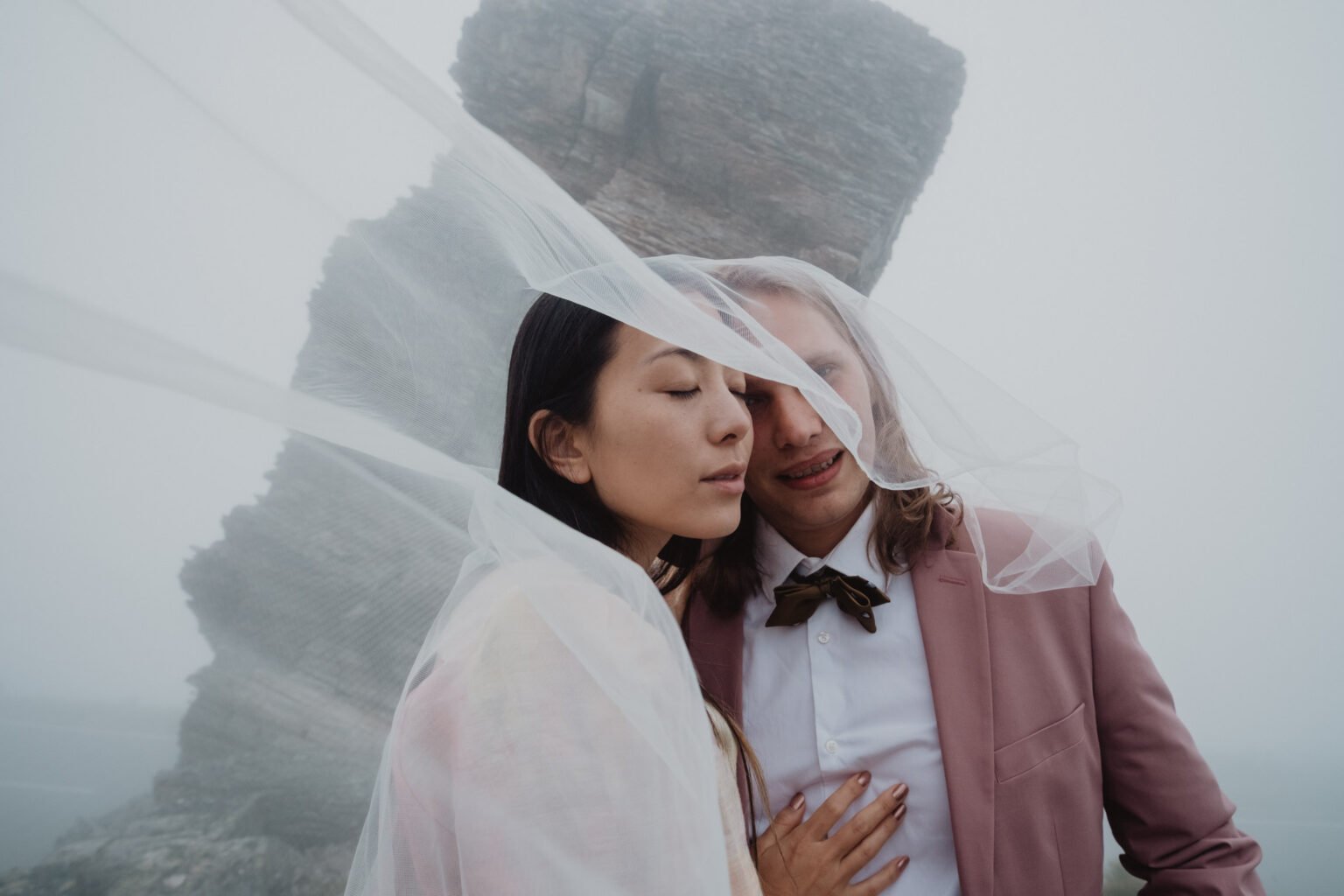
Soft mist can change the whole feeling of a photograph. Your plan still needs to suit the actual conditions.
Do we need to hike? And can our guests come?
You don’t need to make a summit ascent to experience this region. The road reaches the Kaiser-Franz-Josefs-Höhe viewing area at 2,369 metres. Reaching the Grossglockner summit is a separate mountaineering undertaking, not a wedding-day stroll; the road operator’s FAQ makes that distinction clear.
For your day, tell me what “comfortable” means to you: ten minutes on a firm path, a longer walk, no steep edges, somewhere to sit, or a place where a parent can join without managing uneven ground. That information is more useful than saying you are “not very outdoorsy”.
The operator lists accessible facilities, including a lift in the Kaiser-Franz-Josefs-Höhe visitor centre and accessible toilets at several stops. Check its accessibility overview, then confirm the exact route between parking, ceremony space and facilities. Vehicle access does not make every surrounding path accessible.
For children or older relatives, I would favour fewer stops, a reliable meal plan and shelter nearby. If some guests want to return to the hotel before your portraits, decide who travels with whom. A tiny wedding can still benefit from thoughtful transport.
What about glacier photographs?
Seeing a glacier and stepping onto one are different things. The National Park describes the Pasterze glacier trail as a high-alpine route. Past photographs are not proof of present access. We would check current conditions and restrictions; any glacier or technical terrain needs appropriate professional guidance. You can have powerful mountain photographs without turning the day into a climbing objective.
A change since the shoot: the glacier railway
The road operator’s 90-year anniversary publication states that the historic Pasterze funicular has been out of operation since 2025. Do not plan your descent or return around it. Confirm current walking routes and conditions locally, including the climb back up; the drive to the viewing area and a walk into the glacier basin are very different outings.
What could the day actually feel like?
I would begin with a rhythm, then add times after checking your ceremony appointment, location and road access. Here is one possible structure for a Symbolic Wedding Ceremony on the High Alpine Road. Any legal civil marriage is arranged separately; Susanne and Doris coordinate the symbolic ceremony here. It is a planning example, not a fixed itinerary.
01 A slow beginning and time to arrive. Breakfast, getting ready and travelling to the agreed location, with enough breathing room for music, a letter and a familiar cup of coffee.
02 Your Symbolic Wedding Ceremony. A personal ceremony at the agreed location, with time afterwards for hugs and to let your words sink in.
03 A proper pause. Something to eat, time together and, if needed, a short, agreed transfer to your portrait location.
04 Personal vows or portraits. At a suitable, permitted place, within your comfort level and the day’s weather. An organised ceremony needs the relevant arrangements in place.
05 A meal and somewhere warm to return to. Plan your return around access hours. Save energy for enjoying the evening, not just making it back.
If the legal ceremony is on another date, that space could become a longer breakfast, a gentle walk or more time in one place. If you want both a glacier-landscape outing and a relaxed sunrise, we can also discuss two days, as with the shoot above. That gives the driving and the experience more room. For an after-wedding shoot, we can keep the experience even simpler. You don’t need to fill every hour to justify choosing a beautiful location.
What should we budget for?
There is no single “Grossglockner elopement price”. A civil ceremony plus a quiet photo experience is a different booking from a coordinated symbolic wedding with guests. Before comparing totals, decide what each quote actually includes.
The experience & your team
Photography, film if you want it, ceremony coordination or a celebrant where relevant, and any specialist mountain guidance. Check coverage hours, travel and what happens if conditions change.
The place & access
Any ceremony or venue fees, required permissions, road access, transport and parking arrangements. A road ticket is not permission to hold a wedding or a commercial shoot anywhere you choose.
Your stay & celebration
Accommodation, getting-ready space, meals, flowers, clothing and any guest arrangements. Allow room for a comfortable alternative if the outdoor plan changes.
As a reference only, the operator lists a standard car day ticket at €46.50 for 2026; future prices may differ. Use the current price list when you book, and clarify access costs for each supplier’s vehicle. My elopement photography packages and film options explain my own services; venue, road and ceremony services need their own confirmation.
Photos, film and the parts that feel like you
There is a temptation in a place like this to chase the biggest view all day. I’m interested in what happens between those views as well: the way you hold each other when it is cold, a veil caught in soft light, the coffee you make together, a moment when nobody needs to say anything.
My background as a professional dancer shapes how I see movement and rhythm. I want your photographs to feel alive, without asking you to become different people for the camera. We can make room for stillness and for the landscape, while letting your own connection lead.
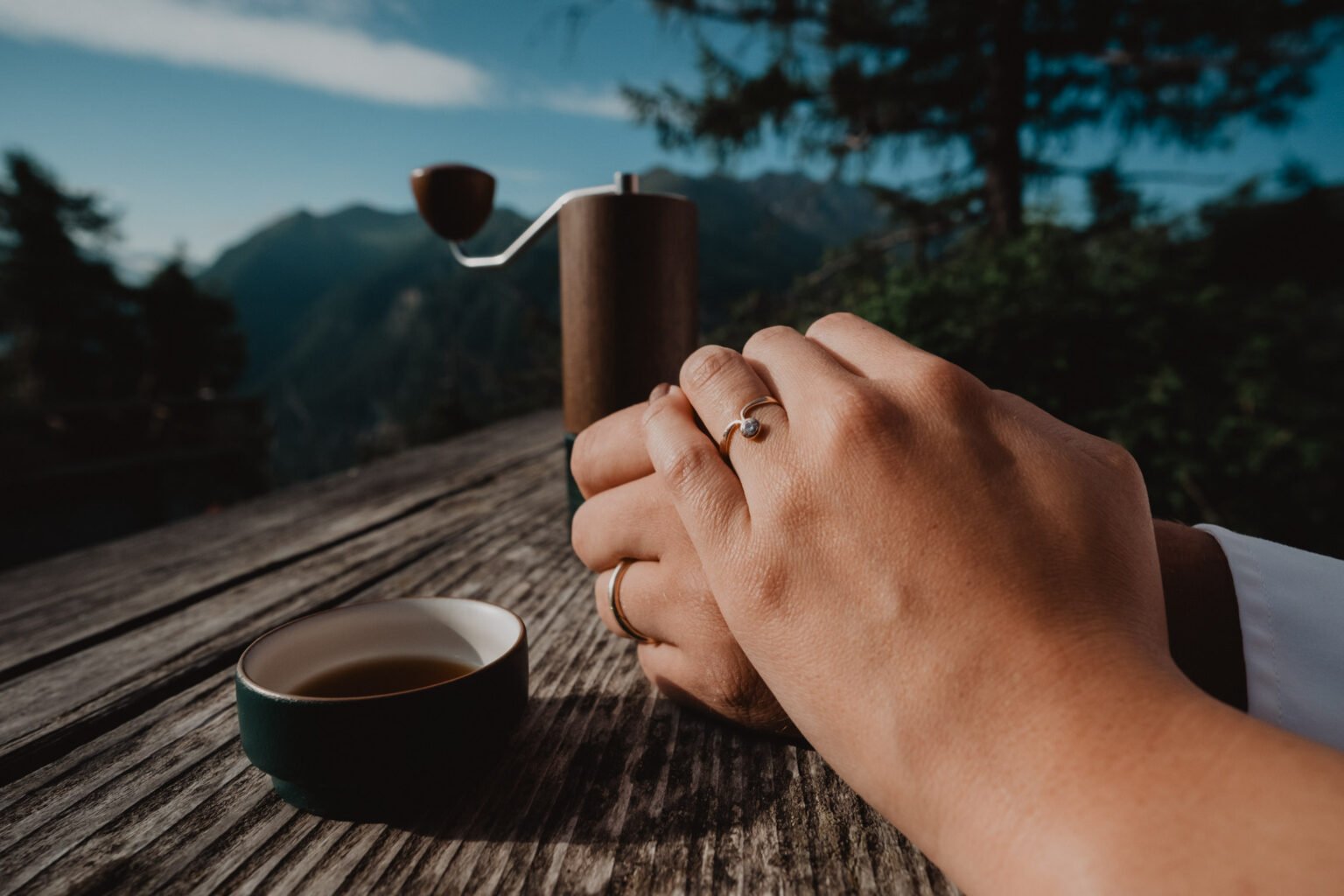
The small details are part of the story, not a break from it.
If you are drawn to film, we can talk about a documentary elopement film or The Cinematic Elopement Experience. Your voices, movement and atmosphere can tell a different part of the day. Shapes of Aether, my dance-film work in Iceland, shows another side of my visual language; it is an artistic reference, not footage of a real wedding.
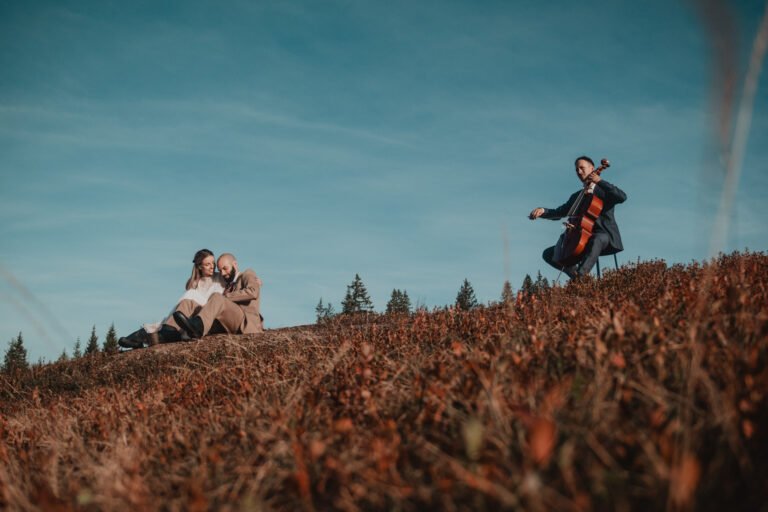
Music can also be personal without becoming a public performance on the mountain. A musician at an appropriate private venue or during dinner may suit your day beautifully. Tell me what you imagine and we can discuss my personal connections with musicians, the setting and any permissions needed.
Weather, privacy and looking after the place
The backup should feel like a day you would still choose. Before the date, I would want us to know what can move, what is fixed and who makes each decision. A registry-office appointment, a booked meal and a road closure each affect the plan differently.
If the forecast changes
We can discuss a lower-altitude location, a sheltered part of the day, a different sequence or an alternative photo session if your booking and travel allow it. None of those should be assumed: agree on the practical and contractual options beforehand. In unsafe conditions, the original outdoor location comes off the plan.
Check the official road status and webcams close to the day. A webcam helps you see what is there now; it does not replace a mountain forecast or a local assessment.
If a viewpoint is busy
The road and its viewpoints are public visitor spaces. We can plan thoughtfully around the place and timing, but I won’t promise that a popular view will belong only to you. If complete privacy matters, an agreed private ceremony setting may be the better starting point.
A small footprint
The National Park’s visitor rules include staying on paths, avoiding unnecessary noise, taking rubbish home and not picking plants. Drones, fires and camping are prohibited under its normal visitor rules. We would check the exact location and any separate permissions rather than assuming the road ticket covers everything. Leave confetti and decorations that could escape into the landscape out of the plan.
The marmots were a lovely part of our visit. If you see them, give them space and please don’t feed them—even if other visitors do. Wildflowers, including edelweiss, stay where they grow.
Pack shoes you can walk in, warm layers, rain protection, water, food and any personal essentials. A dress can travel in a garment bag; you do not have to negotiate every path already dressed for photographs.
A few questions couples often ask
Is Grossglockner in Styria?
No. The mountain lies between Carinthia and East Tyrol; the High Alpine Road also takes you through Salzburg. If you are comparing Austrian regions, my location guide will help you look beyond one famous name.
Can we do this with just the two of us?
Yes, an intimate experience for two is possible. For the civil ceremony, confirm the arrangements directly with your registrar. For an organised ceremony on the High Alpine Road, use the operator’s designated wedding team. Small does not mean permission-free.
Can we combine Kals and Heiligenblut in one day?
Treat them as separate approaches, not neighbouring photo stops connected over the mountain. I would normally choose one side for an elopement day. If both matter to you, consider separate days and check the actual driving route before booking.
Is this better than Tyrol or the Dolomites?
That depends on what you want to feel and do. Grossglockner may draw you through its glacier landscape; another place might better fit your ceremony, season, accessibility or wish for a shorter day. Compare my Tyrol elopement guide, Dolomites guide and Hallstatt and Dachstein story. You don’t need the most famous mountain to have the right day.
Can we book you before deciding the exact location?
You can get in touch while the location is still an idea. Tell me your likely dates, whether it is just you or a few guests, and whether the legal ceremony belongs on the same day. We can then see whether my approach and availability fit before working through the details together.
A mountain day that feels like yours
Tell me what brought you here: the glacier, the sense of space, a quiet ceremony, or simply the idea of doing this together. You don’t need a finished itinerary to begin. I’d love to hear what you’re imagining.
Written by Elias Choi-Buttinger, Austrian elopement photographer and filmmaker. Photographs from my work in the Grossglockner region. Practical information checked on 19 November 2026; access, prices and ceremony arrangements can change. Confirm your plans with the relevant operator, registry office and venue before booking.